
XINING, China, Aug. 31, 2026 /PRNewswire/ — A Report from Science and Technology Daily:
In the 20 years since it opened, the 1,956-kilometer Qinghai-Xizang Railway has delivered a remarkable record: 104 million passengers and more than 824 million tonnes of freight transported across the “roof of the world.” The landmark project has transformed the region’s connectivity, economy, and way of life.
Improving livelihoods
Stretching from Xining in Qinghai province in the east to Lhasa in the Xizang autonomous region in the west, the Qinghai-Xizang Railway has enabled people, goods, and the unique resources of the plateau to flow across mountains and valleys, boosting markets and industries.
The Xizang Gaerde Ecological Livestock Industry Development Co., Ltd., for example, located deep in the Qiangtang grassland, has leveraged railway cold-chain transportation to deliver perishable fresh milk to markets across China, helping increase the incomes of thousands of local herder households. At Qarhan Salt Lake in Qinghai, potash fertilizer production lines are seamlessly connected with railway terminals. In 2025, more than four million tonnes of potash fertilizer was transported by rail.
The railway has reshaped the economic landscape of Xizang and transformed the lives of countless people.
Every June, as cordyceps, a parasitic fungi with high medicinal value, enters its peak trading season, the Qinghai Jiuying Cordyceps Trading Market near the Xining railway station becomes one of the busiest places in the region, attracting merchants from across the country.
“In the past, we had to drive for days to purchase cordyceps. Now herders can simply take the train and bring their products here,” said Ma Ke, a trader who has been doing business at the market for more than 20 years. “The railway has brought the market to life.”
Today, the Jiuying Cordyceps Trading Market has more than 20,000 businesses and an annual transaction volume exceeding 10 billion RMB. During the peak season, more than 5,000 railway express parcels are handled every day. The railway has not only shortened transportation times but also helped bring the region’s specialty products to the national market.
Where transportation networks expand, industries thrive. More and more agricultural and livestock products from the Qinghai-Xizang plateau are reaching markets beyond the region, while increasing numbers of visitors are traveling to the plateau. Over the past two decades, Xizang’s GDP has grown more than ninefold, while Qinghai’s economic output has also surged significantly.
Protecting the environment
The Qinghai-Xizang plateau is the source of the Yangtze, Yellow, and Lancang rivers and serves as a crucial ecological security barrier for the world. From the very beginning of its construction, the Qinghai-Xizang Railway adopted a comprehensive environmental supervision system for the entire railway line — the first of its kind in China. It incorporated wildlife corridors, constructing bridges and passages for animal migration, and restoring fragile alpine grassland ecosystems. These efforts have created a new model for harmonious coexistence between railway development and nature.
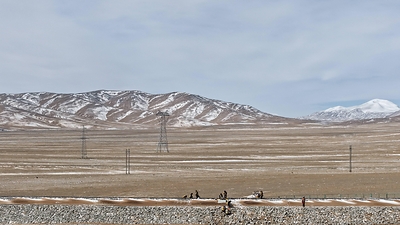
An over 1,000-kilometer green corridor stretches along the foothills of the Kunlun Mountains. Nearly 8 million square meters of vegetation have restored life to the once barren Gobi landscape, while dozens of wildlife passages have remained unobstructed.
Thanks to sustained protection efforts, the Tibetan antelope population in the Xizang autonomous region has increased to over 300,000 at present. Populations of other rare wildlife, including Tibetan wild donkeys, wild yaks, and black-necked cranes, have steadily increased, indicating a continued positive trend in the plateau’s ecological health.
Expanding openness
On June 28, the first “Xining–Balkhan” Central Asia freight train departed from Shuangzhai station in Xining,Qinghai province. Carrying cargo in 55 container cars, the cross-border train traveled 5,420 kilometers, leaving China via the Khorgos Port. It then traversed through Kazakhstan before reaching the ultimate station in Turkmenistan. The entire journey took approximately 14 to 15 days.
The launch marked further expansion of cross-border logistics links between the Qinghai-Xizang plateau and Central Asia. Since the first international freight train service began operating in 2016, Qinghai’s international freight trains have connected 16 cities in 10 countries, accelerating the development of a diversified, efficient, and interconnected international logistics network.
“In 2025, the Xizang autonomous region’s total foreign trade value reached 8.479 billion RMB, surpassing the 6 billion RMB target set in the 14th Five-Year Plan (2021-2025). Exports of combed pure wool yarn, wine, and Tibetan incense increased 80-fold, 17-fold, and twofold year on year, respectively,” said Dan Zeng, an official at Lhasa Customs. “Products such as fragrant pork from Nyingchi and red wine from Shannan achieved their first-ever exports, while natural drinking water from the Ngari region successfully entered the South Asian market.”
 View original content to download multimedia:https://www.prnewswire.com/news-releases/20-years-on-qinghai-xizang-railway-continues-to-reshape-the-region-302865065.html
SOURCE Science and Technology Daily
