
National Debt Relief survey finds resilience runs deep among Hispanic American community, more trusted financial support needed
NEW YORK, April 16, 2026 /PRNewswire/ — National Debt Relief, the industry leader in debt settlement and provider of the most popular debt relief solution in the U.S.*, today released findings from a new survey conducted in partnership with Talker Research, revealing Hispanic Americans experience greater financial pressure than non-Hispanics, including higher rates of debt, greater debt-related stress and reduced access to financial education. Yet, they remain more optimistic about achieving the American Dream, underscoring a resilience that persists despite challenges.
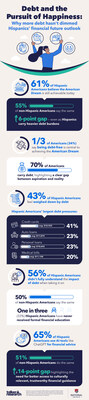
The survey of 2,000 U.S. adults, including 1,000 Census-representative Hispanic respondents split evenly between Spanish-speakers and English-speakers, also highlights disparities exist between English-speaking and Spanish-speaking Hispanic Americans. Notable takeaways include:
- 72 % of Hispanic Americans carry debt, compared to 68% of non-Hispanics
- Hispanic respondents’ biggest debt loads are:
- Carrying credit card debt month-to-month — 41%, avg. $10,933
- Auto loans — 23%, avg. $17,875
- Personal loans (bank, credit union, friend/family member, etc.) — 23%, avg. $10,642
- Medical bills — 20%, avg. $11,150
- 43% of Hispanic Americans feel weighed down by debt (vs. 37% of non-Hispanics)
- Three in five (61%) Hispanic Americans believe in the American Dream, outpacing non-Hispanics (55%)
- Optimism for the American Dream rises further among Spanish-speaking Hispanic Americans (66% vs. 56% of English-speaking Hispanics)
- One in three (33%) Hispanic Americans have never received formal financial education
- 65% of Hispanic Americans are turning to AI tools like ChatGPT for personal finance guidance (vs. 51% of non-Hispanics)
“This data isn’t just about debt and financial challenges, it’s about hope. Hispanic Americans face greater financial pressure by nearly every measure. Yet, they remain more likely to believe the American Dream is still within reach,” said Bryce Williamson, Senior Vice President of Client Loyalty, National Debt Relief. “That optimism speaks to resilience and to an opportunity. With the right support, more Americans can turn that belief into financial progress.”
How Is Debt Impacting U.S. Hispanic Americans?
As 72% of Hispanic Americans carry debt, the findings show that Hispanics more often take on debt without fully understanding its potential impact, and the effects are lasting.
- 56% did not understand the impact of debt at the time they took it on (vs. 50% of non-Hispanics), with Spanish-speakers more likely to report this gap than English-speakers (59% vs. 53%)
- 43% feel weighed down by debt (vs. 37% of non-Hispanics), rising to 48% among English-speakers compared to 37% of Spanish-speakers
Among all respondents with current or past debt, the burden of debt is shaping everyday financial decisions. While the overall impact between Hispanics and non-Hispanics is largely similar, differences emerge between English- and Spanish-speaking Hispanic Americans and may point to varying cultural motivations.
- English-speaking Hispanic Americans:
-
- 45% say debt limited their ability to save (vs. 39% of Spanish speakers)
- 39% report debt lowered their credit score (vs. 22% of Spanish speakers)
- 29% note that debt kept them from doing things they enjoy and pursuing hobbies and interests (vs. 21% of Spanish speakers)
- Spanish-speaking Hispanic Americans:
-
- 29% are more cautious about borrowing due to debt (vs. 26% of English-speakers)
- 29% point to debt being a motivator for them to work harder (vs. 23% of English-speakers)
- 22% denote debt left less room in their budget to help family financially or send money to family outside of the country (vs. 16% of English-speaking Hispanics)
Are Hispanic Americans Talking About Debt With Family?
While some might assume discussing issues like finances and debt is taboo for Hispanic Americans, they are more likely than the general population to talk about finances with their families. However, those conversations often stop short of discussing the details of personal finances and debt-related hardships.
- 53% of Hispanic Americans frequently discuss money at home vs. 41% of non-Hispanics, with Spanish-speaking Hispanic Americans over-indexing by seven points (57% vs. 50% of English-speaking Hispanics)
- Conversations within Hispanic American households tend to focus on foundational topics like the risks of debt (42%), how credit cards work (42%) and budgeting (41%)
- But far fewer say it’s appropriate to discuss real world financial circumstances, including how much debt a parent has (15%), parents’ income (16%) or family financial strain (18%)
Hispanic American households are engaging in financial conversations, focused on concepts rather than lived financial realities. That disconnect points to a deeper issue, not a lack of willingness to engage, but instead barriers to accessing the tools and guidance needed to go further.
- 33% of Hispanic Americans have never received formal financial education, and 1 in 10 (10%) say they have no access at all to trustworthy, relevant guidance
- Hispanic Americans also indicate a greater desire to know more about debt (36% vs. 24%), savings (43% vs. 30%), taxes (37% vs. 29%) and mortgages (30% vs. 19%) at higher rates than non-Hispanics
- In response, many are seeking out alternative sources, with 65% of Hispanic Americans using AI tools like ChatGPT for financial advice vs. 51% of non-Hispanics, with Spanish-speaking Hispanic Americans over-indexing by 11 points (71% vs. 60%)
Together, these behaviors reveal a community that is actively seeking answers, even in the absence of traditional resources. It suggests that access to relevant, culturally competent financial education and support plays a critical role in helping more Hispanic Americans achieve tangible financial progress.
How Can Hispanic Americans Turn Belief in the American Dream into Reality?
The hunger for financial resources is especially important given the finding that financial pressure is not dampening optimism among Hispanic Americans.
- 61% believe in the American Dream, outpacing non-Hispanics (55%), and Spanish-speaking Hispanic Americans believe in the American Dream at greater rates then their English-speaking counterparts (66% vs. 56%)
- Hispanic American respondents (38%) are more likely than non-Hispanic respondents (33%) to view the American Dream as more achievable today than it was 20 years ago
- They maintain that outlook even while being more likely than non-Hispanics to carry credit card debt month-to-month (41% vs. 36%), have auto loans (23% vs. 20%), personal loans (23% vs.18%), and debt tied to Buy Now Pay Later (BNPL) (17% vs. 15%)
“There’s a clear drive within the Hispanic American community to learn and move forward, but cultural barriers and limited access to trusted, relevant guidance can make it harder to take the next step,” added Williamson. “At National Debt Relief, we see how overwhelming unsecured debt can hold people back. That’s why we focus on meeting people where they are, offering clear, practical support, including Spanish language resources, to help them navigate their options, reduce debt and build a more stable financial future.”
How Can Debt Settlement Help Americans with Financial Challenges?
The definition of the American Dream is evolving. As rising economic pressures reshape Americans’ priorities, financial success is now increasingly defined as a state of stability. These increased pressures shape how Americans view their financial future, what they aspire to achieve and why being debt-free is now central to the American Dream.
- Seven in 10 Americans carry debt, including unsecured debt such as credit cards (39%, avg. $11,246), medical bills (22%, avg. $11,158) and auto loans (21%, avg. $17,469)
- 34% of Americans define the American Dream as “being debt-free,” ranking as the #3 criterion overall, behind only homeownership (41%) and having an emergency fund (35%)
For the millions of Americans managing growing unsecured debt balances, debt settlement can offer a path forward.
- Debt settlement is an option for anyone with more than $7,500 of unsecured debt, including credit card debt, medical bills and personal loan debt.
- For those ready to turn hope into action, the National Debt Relief debt settlement program helps clients get out of debt faster than making minimum payments, avoid bankruptcy, and pay less than what they originally owe in manageable payments built around their budget.
- Learn more at NationalDebtRelief.com or call 1-800-718-0487 for a free, no-obligation consultation with a certified debt specialist. Spanish-speaking certified debt specialists are available to assist.
About National Debt Relief
Since 2009, National Debt Relief has helped people face their debt with confidence. As the debt settlement industry leader, we make the process of getting out of debt less overwhelming and more empowering. National Debt Relief is a Better Business Bureau A+ accredited business, Forbes Advisor’s top-rated debt relief company for four consecutive years and is the most highly reviewed and rated debt settlement company on ConsumerAffairs. We have helped over 1.3 million people take meaningful steps toward resolving their debt so they can feel financially and emotionally whole again. Learn more at NationalDebtRelief.com.
Survey Methodology
The National Debt Relief survey was conducted by Talker Research among 2,000 U.S. adults, including 1,000 Census-representative Hispanic respondents (split evenly between Spanish-speaking and non-Spanish-speaking) and 1,000 non-Hispanic respondents. The survey was conducted online between March 6 and 16, 2026. Data met quality standards through multiple verification methods including captcha and deduplication. Statistical significance was calculated at the 95% level.
References
* Forbes Advisor 2026. See: https://www.forbes.com/advisor/debt-relief/best-debt-relief-companies/?award=best-debt-relief-companies-award-2026-national-debt-relief/
 View original content to download multimedia:https://www.prnewswire.com/news-releases/big-dreams-bigger-barriers-us-hispanics-more-optimistic-about-future-despite-more-debt-302743829.html
SOURCE National Debt Relief
